
Solution to puzzle 124: The ladder
A ladder, leaning against a building, rests upon the ground and just touches a box, which is flush against the wall and the ground. The box has a height of 64 units and a width of 27 units.
Find the length of the ladder so that there is only one position in which it can touch the ground, the box, and the wall.
There are many ways to parameterize this problem, and many different approaches.
Non-calculus Solution
First of all, we generalize the dimensions of the box to r × s; see below. Let the distance above the box at which the ladder touches the wall be x, and let the corresponding horizontal distance be y. Let the ladder have length d.
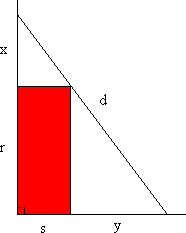
Applying Pythagoras' Theorem, (r + x)2 + (s + y)2 = d2.
By similar triangles, x/s = r/y, and so y = rs/x.
Hence (r + x)2 + (s + rs/x)2 = d2.
Expanding, and collecting terms, we obtain an equation in x:
f(x) = x2 + 2rx + (r2 + s2 − d2) + 2rs2/x + r2s2/x2 = 0. (1)
Multiplying by x2, we obtain (since x = 0 is not a root) an equivalent polynomial equation in x:
p(x) = x4 + 2rx3 + (r2 + s2 − d2)x2 + 2rs2x + r2s2 = 0. (2)
Clearly d2 > r2 + s2, and so by Descartes' Sign Rule, this equation has 2 or 0 positive real roots (counting multiplicity.)
We seek the value(s) of d for which the equation has two identical roots.
p has repeated root a if, and only if, p(x) = (x − a)2(x2 + bx + r2s2/a2), for some a and b, to be found. (The constant term in the second quadratic factor is determined by that in the first, given that their product must equal r2s2.)
Expanding, p(x) = x4 + (b − 2a)x3 + (a2 − 2ab + r2s2/a2)x2 + (a2b − 2r2s2/a)x + r2s2 = 0.
Equating coefficients of x3 and x with (2), we obtain:
b − 2a = 2r,
a2b − 2r2s2/a = 2rs2. (3)
Substituting b = 2(a + r) into (3), multiplying by a, and rearranging, we get
2a3(a + r) = 2(a + r)rs2.
Since a + r  0, we deduce that a3 = rs2.
Hence a = r1/3s2/3, and b = 2(a + r) = 2r1/3s2/3 + 2r.
Equating coefficients of x2, we obtain:
| r2 + s2 − d2 | = a2 − 2ab + r2s2/a2. |
| = r2/3s4/3 − 4r2/3s4/3 − 4r4/3s2/3 + r4/3s2/3. | |
| = − 3r2/3s4/3 − 3r4/3s2/3. |
Hence d2 = r2 + s2 + 3r2/3s4/3 + 3r4/3s2/3 = (r2/3 + s2/3)3.
(Note the pleasingly symmetrical form: d2/3 = r2/3 + s2/3.)
Finally, substituting r = 64 = 43 and s = 27 = 33, we get d2 = (42 + 32)3 = (52)3, so that d = 53 = 125.
Therefore, the length of the ladder so that there is only one position in which it can touch the ground, the box, and the wall, is 125 units.
An alternative way to determine the repeated root
Having derived equation (1), above, f(x) = x2 + 2rx + (r2 + s2 − d2) + 2rs2/x + r2s2/x2 = 0, we can determine a repeated root by considering f'(x) = 0. This is a standard result for polynomials, and can easily be shown to hold for rational functions.
Lemma
Let R(x) = P(x)/Q(x), where P and Q are polynomials, be defined over  .
.
Then R(a) = R'(a) = 0  x = a is a repeated root of R.
Proof
The proof is similar to that for polynomials.
Suppose R(a) = R'(a) = 0.
R(a) = 0  P(a) = 0 P(x) = (x − a)S(x), where S(x) is a polynomial. (By the Polynomial Factor Theorem.)
Hence Q(x)R(x) = P(x) = (x − a)S(x).
Differentiating using the product rule, we get Q'(x)R(x) + Q(x)R'(x) = (x − a)S'(x) + S(x).
Since R(a) = R'(a) = 0, we obtain 0 = S(a); that is, S(x) = (x − a)T(x), for some polynomial T(x).
Hence P(x) = (x − a)2T(x), and a is a repeated root of P, and therefore of R.
Now suppose x = a is a repeated root of R, in which case x = a is a repeated root of P.
Then P(x) = (x − a)2T(x), for some polynomial T(x).
Hence P'(x) = 2(x − a)T(x) + (x − a)2T'(x), and so P'(a) = 0.
Clearly also P(a) = 0.
Using the quotient rule, R'(x) = [Q(x)P'(x) − P(x)Q'(x)]/[Q(x)]2.
Hence, since P(a) = P'(a) = 0, R'(a) = 0.
Clearly also R(a) = 0, and the result follows.
We may now apply this result to rational function f(x) = x2 + 2rx + (r2 + s2 − d2) + 2rs2/x + r2s2/x2.
We have f'(x) = 2x + 2r − 2rs2/x2 − 2r2s2/x3 = 2x−3(x + r)(x3 − rs2).
(Notice that the constant term of f has disappeared, leaving f'(x) as a rational function with coefficients depending only upon r and s.)
If f'(x) = 0, rejecting the negative root, we obtain repeated root x = r1/3s2/3.
Then y = rs/x = s1/3r2/3.
| Hence d2 | = (r + r1/3s2/3)2 + (s + s1/3r2/3)2. |
| = r2/3(r2/3 + s2/3)2 + s2/3(s2/3 + r2/3)2. | |
| = (r2/3 + s2/3)(r2/3 + s2/3)2. | |
| = (r2/3 + s2/3)3. |
Given the above lemma, this approach is considerably simpler.
Remarks
The above solution is identical to that for the following ladder problem: Given that two hallways of widths 27 and 64 units meet at a corner, what is the length of the longest ladder that can be carried horizontally around the corner? A succinct trigonometric solution using calculus is given here: Longest ladder.
How can we show that the "unique position" ladder problem is equivalent to the "longest (or shortest)" ladder problem?
Further reading
- Ladder Problems
 The Ladder Problem. (See page 2.)
- The Longest Ladder
Source: Christian Ginsbach