
Solution to puzzle 115: Sum of sines
Let f(x) = sin(x) + sin(x°), with domain the real numbers. Is f a periodic function?
(Note: sin(x) is the sine of a real number, x, (or, equivalently, the sine of x radians), while sin(x°) is the sine of x degrees.)
If f is periodic then so is its derivative, f '. This follows by considering the definition of f '. If f has period T, then, for any a:
![f'(a) = limit as h tends to 0 of [f(a+h)-f(a)]/h = limit as h tends to 0 of [f(a+T+h)-f(a+T)]/h = f'(a+T)](../puzzles/p115s1.gif)
We will show that f ' is not a periodic function and, hence, neither is f.
We have f(x) = sin(x) + sin(x°) = sin(x) + sin( x/180). (Since 360° = 2 radians.)
Hence f '(x) = cos(x) + (/180) cos(x/180).
Clearly, f '(0) = 1 + /180 is the maximum value of f ', attained only when both cosines are equal to 1.
Suppose f has period T. Then f '(T) = f '(0).
But f '(T) = cos(T) + (/180) cos(T/180).
Hence cos(T) = 1 and cos(T/180) = 1.
cos(T) = 1  T = 2n, for some integer n.
cos(T/180) = 1 T/180 = 2m, for some integer m. Hence T = 360m.
Combining these two results, we conclude that = 180m/n.
We have reached a contradiction, as is known to be irrational.
Hence f ' is not a periodic function.
Therefore, f is not a periodic function.
Remarks
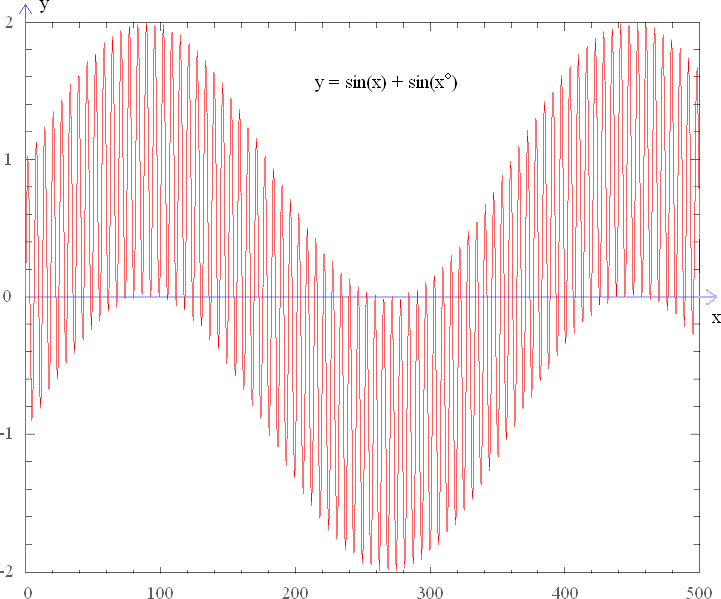
The graph of f for 0  x 500 is shown below.
Further reading
Source: Original