
Solution to puzzle 73: Unobtuse triangle
A triangle has internal angles A, B, and C, none of which exceeds 90°. Show that
- sin A + sin B + sin C > 2
- cos A + cos B + cos C > 1
- tan (A/2) + tan (B/2) + tan (C/2) < 2
sin A + sin B + sin C > 2
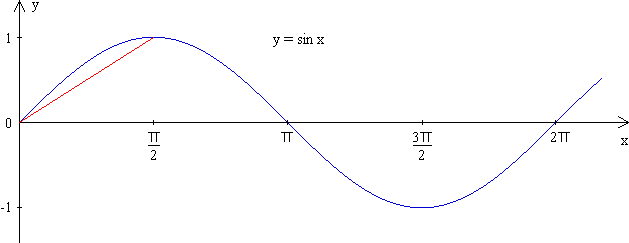
Consider the graph of y = sin x, below, and the line segment joining the origin to the point ( /2,1).
Note that the second derivative, y'' = −sin x, is negative for 0 < x < /2, and so that section of the graph is concave.
The equation of the line segment is y = (2/) · x. Note that the line segment intersects the concave curve at x = 0 and x = /2.
Hence, for 0 < x  /2, we have sin x
  (2/) · x, with equality only for x = /2.
Since 0 < A, B, C /2, with equality in at most one case, we have: sin A + sin B + sin C > (2/) · (A + B + C).
Since A + B + C = , it follows that sin A + sin B + sin C > 2.
By judicious choice of line segment we can similarly establish the other two results.
cos A + cos B + cos C > 1
Consider the graph of y = cos x, below, and the line segment from (0,1) to (/2,0).
The second derivative, y'' = −cos x, is negative for 0 < x < /2, and so that section of the graph is concave.
The equation of the line segment is y = 1 − (2/) · x.
Hence, for 0 < x /2, we have cos x 1 − (2/) · x, with equality only for x = /2.
Then cos A + cos B + cos C > 3 − (2/) · (A + B + C).
Therefore cos A + cos B + cos C > 1.

tan (A/2) + tan (B/2) + tan (C/2) < 2
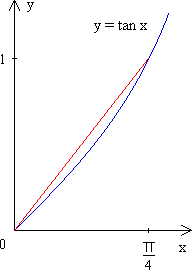
Finally, consider the graph of y = tan x, and the line segment from the origin to (/4,1).
The second derivative, y'' = 2 tan x sec2 x, is positive for 0 < x < /4, and so that section of the graph is convex.
The equation of the line segment is y = (4/) · x.
Hence, for 0 < x /4, we have tan x (4/) · x, with equality only for x = /4.
Then tan (A/2) + tan (B/2) + tan (C/2) < (4/) · (A/2 + B/2 + C/2).
Therefore tan (A/2) + tan (B/2) + tan (C/2) < 2.
Remarks
A real-valued function is said to be convex on an interval I if, and only if
f(ta + (1 − t)b) tf(a) + (1 − t)f(b)
for all a, b in I and 0 t 1. It can be shown that if f''(x) 0 for all x in I, then f is convex on I. A real-valued function is said to be concave on an interval I if, and only if, −f is convex on I.
Further reading
- Jensen's Inequality
 Inequalities and Triangles
- Triangle Inequalities
Source: Original