
Solution to puzzle 59: Triangle inequality
A triangle has sides of length a, b, and c. Show that 
Left inequality
The left side of the inequality is, in fact, true for all triples (a, b, c) of positive real numbers. We can prove it using the rearrangement inequality, stated below.
Let a1  a2 ... an and b1 b2 ... bn be real numbers. For any permutation (c1, c2, ..., cn) of (b1, b2, ..., bn), we have:
a1b1 + a2b2 + ... + anbn  a1c1 + a2c2 + ... + ancn a1bn + a2bn−1 + ... + anb1,
with equality if, and only if, (c1, c2, ..., cn) is equal to (b1, b2, ..., bn) or (bn, bn−1, ..., b1), respectively.
That is, the sum is maximal when the two sequences, {ai} and {bi}, are sorted in the same way, and is minimal when they are sorted oppositely.
Now we apply the rearrangement inequality to suitably chosen sequences. Specifically, we will use the result that the sum is maximal when the two sequences are sorted in the same way.
Without loss of generality, assume a b c.
Then the sequences {a, b, c} and 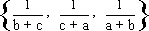 are sorted the same way.
We twice rotate the second sequence, and apply the rearrangement inequality, to obtain:
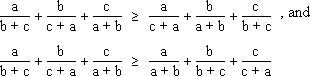
Adding these two inequalities, and dividing by two, we get 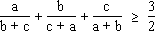
We must also show that equality can occur, which is readily seen by setting a = b = c.
Right inequality
In order to prove the right inequality, we must use the fact that a, b, c are the sides of a triangle.
Let s = ½(a + b + c) be the semi-perimeter of the triangle.
In any triangle, a + b > c, and so a + b > s.
Hence  and similarly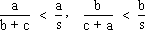
Adding the three inequalities, we get 
Therefore 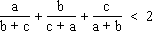
Additional puzzle
The following inequality is due to Gheorge Eckstein.
Let a, b, x, y, z be positive real numbers. Show that:

Further reading
 The Rearrangement Inequality by K. Wu and Andy Liu -- a tutorial that shows how to derive many other inequalities, such as Arithmetic Mean - Geometric Mean, Geometric Mean - Harmonic Mean, and Cauchy-Schwartz, from the Rearrangement Inequality.
- The left inequality is known as Nesbitt's Inequality.
- Shapiro's Cyclic Sum Constant
Source: Traditional